
Every year, floods strike everywhere, from cities to coastlines and valleys. That is very scary! It really worries us the idea of being trapped in such a situation, at home or in a different country. Just think about it: you are in Italy, Vietnam, the US, or Mexico on holiday, and suddenly a tropical storm or a river or dam overflow occurs. Are you ready to survive the floods? Do you know what to do if the water becomes a mortal threat? Streets can turn to rivers in a matter of minutes, sweeping away cars, buildings, trees, and people; everything in its way. It is not an exaggeration, and unfortunately, no guys, being an excellent swimmer is no guarantee of survival when a flood occurs. Let’s prepare right now to be ready for the unexpected! Read this flood safety guide until the end before it is too late!

Deadly floods 2025
This is only a small sample of evidence to prove that deadly floods are happening everywhere, resulting in plenty of catastrophes, significant loss of life, and extensive damage.
- February. During late January and February, intense monsoonal rains driven by a tropical low-pressure system struck northeastern Queensland, Australia. The heavy rainfall caused rivers to overflow and triggered widespread flooding in coastal towns. Thousands were evacuated. The disaster resulted in one immediate fatality and led to a post-flood outbreak of melioidosis, which claimed thirty-one more lives.
- February. In the middle of the month, an Arctic cold front unleashed a merciless storm over Kentucky, Appalachia, and parts of Tennessee and West Virginia, US. The relentless precipitation over mountainous terrain inundated several areas, reaching 8–9 inches (20.32–22.86 centimeters) of water in only a few hours. It triggered deadly flash floods that quickly overwhelmed rivers and drainage, sweeping through dozens of roads and rural hollows, forcing over one thousand rescues, and killing eleven people (most drowned when houses collapsed).
- March. Months of unrelenting rains spilling over Bolivia from late 2024 caused widespread deadly floods in the country, killing dozens and displacing three hundred and seventy thousand families.
- June. Pakistan got hit by monsoon rains, which rapidly triggered flash floods and landslides, particularly affecting Khyber Pakhtunkhwa and causing approximately eight hundred deaths and massive destruction.
- June. A heavy rain-induced glacial lake outburst caused the collapse of a reservoir dam in the Andarab Valley, Baghlan province, Afghanistan. Deadly flash floods arose and washed away five villages, hundreds of hectares of crops, and destroyed mosques and bridges.
- June. It was the turn of the Eastern Cape, South Africa. A powerful cold front unleashed torrential rains that caused rivers to burst their banks, creating disastrous floods, displacing thousands, and killing more than a hundred people.
- July. Central Texas, US, suffered heavy rainfall that triggered devastating flash floods, more than 20 inches (50.8 centimeters) of rain, leading to an emergency situation, widespread evacuations, and infrastructure damage. Fatalities reported were one hundred and thirty-five, and nearly two hundred missing people.
- July. Nepal was struck by a glacial lake outburst flood that destroyed infrastructure and swept away communities near the border with China. Officially, it left twenty-eight deaths.
- July. More than forty people died as a result of heavy rainfall that led to flooding in Beijing, prompting evacuations and emergency responses.
- August. Heavy rainfall created deadly flash floods in Uttarkashi, India, resulting in more than a hundred deaths and an undefined number of missing people.
- October. Mexico joined the scary list. Deadly floods and landslides caused by the remnants of hurricane Priscilla and tropical storm Raymond resulted in significant casualties, damage, and an undefined number of fatalities.
And the year is not over yet... Better keep reading the Pack and Go flood safety guide!
| Follow PackAndGo.info at: | |
| YouTube | @packandgo. |
| @packandgo.info | |
| X | @packandgoinfo |
| Bluesky | @packandgo.bsky.social |
| @packandgo.info | |
| TikTok | @packandgo.info |
Why does a flood happen? Floods vs. Flash floods.
A flood happens when water inundates land that is usually dry. Many causes can be behind the formation of a flood, for instance, heavy rain, glacial lake outbursts, rivers overflowing, melting snow, storm surges from hurricanes, or even the rupture of dams or levees. Floods can last for days or even weeks, slowly spreading and affecting wide areas, damaging homes, roads, crops, and sometimes entire towns or cities.
A flash flood, on the other hand, is a much faster and more dangerous version of a flood. It happens suddenly, frequently within minutes or only a few hours after intense rainfall, a dam failure, or a sudden release of water. Since flash floods happen so quickly, you have little to no time to prepare or escape. You must make decisions really fast to survive. Flash floods can sweep away cars, trees, electricity poles, animals, and even buildings. They are one of the deadliest natural disasters.
The main difference between a flash flood and a regular flood is speed and warning time. Regular floods rise slowly, giving people time to evacuate or protect their property. Flash floods strike fast and hard, often catching people by surprise.
Adding to this destructive power, climate change is making such events more extreme. A warmer atmosphere retains even more moisture; therefore, powerful precipitation and flash floods are happening more frequently.
Why is a flood so deadly?
Floods may seem simple, just too much water, but behind every flood are three key forces that make them so destructive: power, unpredictability, and risk. In other words, the power of water can be massive! Yes, water is far stronger than it looks. Just six inches (15.24 centimeters) of fast-moving water can knock a person off their feet, and two feet (60.96 centimeters) can carry away a car. Consider that floodwater also carries debris, rocks, branches, and pieces of metal that can destroy homes, roads, and bridges. The flatter your area, the longer water may stay, while steep slopes or canyons channel water faster, increasing flash flood danger.
Unlike slow-rising floods from overflowing rivers, flash floods can appear with little or no warning, especially after intense rain, dam ruptures, or when the ground is already soaked and can’t absorb more water. Did you know that urban areas are particularly vulnerable? Yes! The reason is that the concrete and asphalt prevent rain from soaking in, sending it rushing through streets instead.
How to identify the flood risk level of the area where you live?
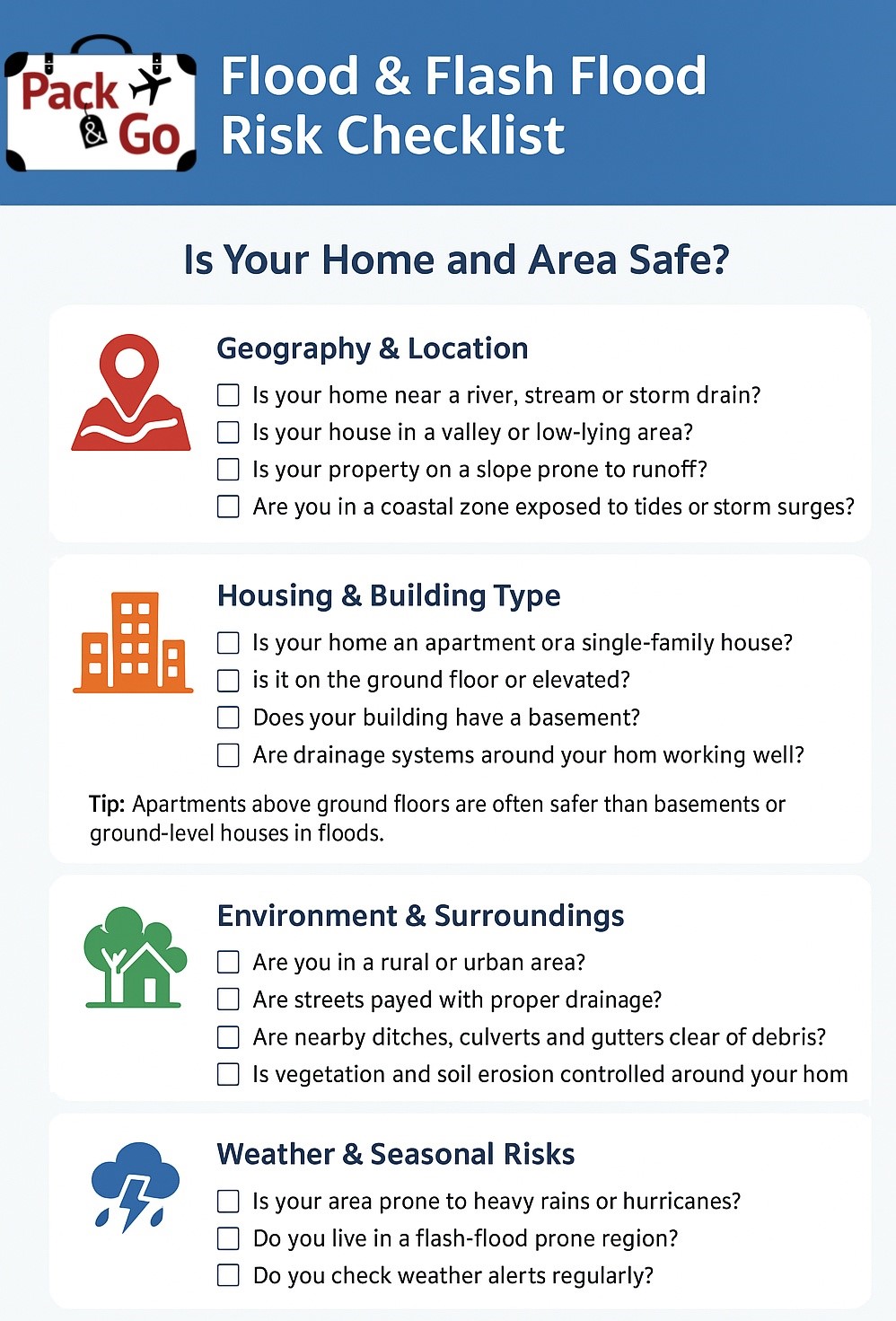
Several conditions can raise or lower your flood risk, and assessing them in advance can save your life. Living near water can be beautiful and even beneficial, with cooler air, fertile soil, and lovely views, but awareness is key. The power of water means floods can change landscapes overnight. So, understanding the terrain, climate, and warning systems around, you can certainly turn unpredictability into preparedness! That is your chance to keep your home and loved ones safe. Check:
- Weather patterns. Regions with hurricane or monsoon seasons face seasonal flood threats, while mountainous areas risk flash floods from melting snow.
- Geography. Where are you? Is your home near a river, stream, or bay? Low-lying regions, valleys, riverbanks, and coastal areas face the highest danger. You can start by observing the terrain around your home. Does the water pool after rain? Are there steep hills or dry creeks nearby? Those are early clues. Watch out and check local floodplain maps for more accurate information.
- Proximity to water structures. Do you live near a dam, levee, or reservoir? That can be a blessing and a risk. Such structures sound like a guarantee of water supply, and yes, they help to control water... until they don’t. Dam failures or overflows can cause catastrophic flash floods.
- Environment. Cities have excellent drainage systems, but during storms, sewers can overflow. Countryside homes near creeks or slopes face risks of flash floods and mudslides. As you see, it is not about fleeing away from the city or the countryside. Floods can happen in both environments. The idea is to assess the risk wherever you live.
- Type of housing. Apartments on upper floors are safer from flooding than single-level houses, but access roads may still flood, trapping residents. Are you a tourist or new to an area where you plan to buy a house or apartment? Ask neighbors or local authorities about past floods to be aware of. History often repeats itself.
How to stay safe during floods?
Floods are silent emergencies; they build fast, strike hard, and leave little time to think. The best protection is preparation, awareness, and knowing what to do when water starts rising. Remember that floods can happen almost anywhere, and climate change has made them more unpredictable and powerful than ever. How to stay safe during floods, no matter where you live (from city apartments to coastal houses)? Here you have a list of smart flood survival tips for every environment.
General flood survival tips
- Stay informed. Keep your phone charged and follow weather apps, local alerts, or radio updates.
- Move to higher ground immediately. Whenever you see fast-rising water, don’t wait for official evacuation; leave without hesitating.
- Never drive, walk, or swim through floodwater. Now you know, just six inches (15.24 centimeters) can knock you down, and two feet (60.96 centimeters) can sweep your car away. Swimming in dark water, with a strong current, you won’t see or avoid debris. Rocks, metal pieces, tree branches, etc., can knock you out and delete your chances of survival. If you did not have time to leave your car (that is your best choice) and get trapped inside it, unbuckle your seatbelt, open your doors and windows before they get blocked due to the pressure of the water outside or a failure in the electric systems. In an extreme case, once the car fills with water, the pressure inside will match the outside, allowing you to open the door.
- Always act quickly. Frequently, you have only a minute to escape before the situation worsens.
- Disconnect electricity. Water and power are a deadly mix. Disconnect it, only if you still have time and it is safe to do so.
- Prepare a go-bag. Include medication, flashlights, food, water, ID, and pet essentials. This bag must be ready in advance for you to take it and leave without wasting time.
- Keep your phone and a power bank dry. Communication saves lives.

Flood survival tips for the city
Remember, cities flood quickly because pavement blocks natural drainage. You are not safe there only because you don’t see a river nearby. If you see fast-rising water, act immediately:
- Avoid underground garages, basements, and subway stations; they fill up first.
- Search for safe zones quickly. Upper floors of solid buildings, parking decks above ground level, and rooftops (if accessible and safe from power lines). Always avoid attics without windows or exits.
- Avoid large intersections and lower-level roads. Storm drains can burst and form whirlpools.
- If in a car, turn around immediately when water crosses the road.

Flood survival tips for the countryside
Rural floods can turn fields into lakes and streams into raging rivers in minutes. Never underestimate them!
- Move livestock and pets to high ground early.
- Stay away from rivers, creeks, and bridges. These structures collapse easily under strong currents.
- If roads flood, stay put until rescue arrives. Consider seriously that rural roads can be really deceptive under murky water.
- Store emergency food, batteries, and clean water. Power and access can be lost for days.
- Move to safe zones. Identify such areas in advance, so, in case of a flood, you don’t waste time and move fast to hilltops, elevated terrain, or upper floors of sturdy homes.

Flood survival tips for the apartment building
Apartment dwellers are safer from direct flooding but must still act wisely and without understimating fast-rising water.
- Move vehicles from the underground parking immediately when heavy rain is forecasted.
- Avoid elevators. If the power cuts, you could get trapped.
- Stay on mid to high floors, but not attics without ventilation.
- If water cuts off exits, move toward balconies or rooftops where rescuers can spot you.
- Go to safe zones. Identify such zones in advance, so in case of emergency, you can go quickly to upper floors, accessible levels, rooftops with a railing, and emergency exits.
Flood survival tips for the house
Know that houses face a higher risk of basement flooding and foundation damage.
- Keep sandbags or flood barriers ready during storm season.
- Elevate electrical outlets, appliances, and valuables when living in flood-prone zones.
- Move family and pets upstairs when flood warnings hit.
- Have an emergency ladder for attic escape if necessary.
- Identify safe zones in your home. Upper floors, attics with roof exits, and second-story rooms away from windows facing strong currents.
Flood survival tips for the valley
Valleys are natural flood funnels. Water from higher areas rushes down really fast. So:
- Leave early if storms are forecasted. Flash floods here are deadly and sudden.
- Know the nearest elevation routes and evacuation points.
- Avoid camping or staying overnight near rivers or creeks during rainy seasons.
- Identify safe zones in advance. Know where to go during the emergency: elevated terrain, ridge lines, high roads far from riverbanks.
Flood survival tips for the coast
Coastal floods combine storm surge, rain, and wind. They can be a deadly mix! So:
- Don’t wait until the water rises. Evacuate inland early.
- Secure windows and doors. Strong waves can break glass.
- Watch for rip currents and debris after the flood. Never return until authorities declare it safe.
- Identify safe zones. Knowing where to go in advance, don’t waste time and run to inland areas, designated hurricane shelters, high-ground hotels, or public buildings.
Flood survival tips for the car
- Always check weather alerts before driving.
- Never park near rivers, ditches, or storm drains during heavy rain.
- Keep an emergency flood tool and flashlight in the car.
- Leave the car. If there is fast-rising water, your best decision is to leave the car and go to a high place, before water gets inside your car or blocks the doors.
- Leave everything behind. Forget bags, phones, or valuables. Your life is the only thing that matters.
- Stay calm and think fast. If you did not leave your car on time and the flood is already significant, don’t panic! That burns time. Take a breath, observe what’s happening, and make a plan. Clear thinking saves lives.
- Turn around, don’t drown. If water is rising on the road, do not drive through it. Just 6–12 inches (15.24 – 30.48 centimeters) can stall your engine, and 2 feet (60.96 centimeters) can sweep your car away.
- Unbuckle immediately. Once water begins entering the car, remove your seatbelt right away so you can move freely.
- Unlock and open all doors and windows. Power systems can fail fast. Open doors and windows immediately, even before water rises. Here, you need to really observe your specific situation and be smart. You can open the windows first and, based on how fast the water is rising, decide whether or not to open the doors. Why? Your best bet is to escape your car as soon as you have a clear opportunity. Many people die in their cars due to blocked windows and doors. This will stop and delay your rescue. Remember that once the water is high, its pressure will block the doors. The same (or a failure in the electric systems) will happen to your windows once the water is high enough to cover them. In an extreme case, once the car fills with water, the pressure inside will match the outside, allowing you to open the door. However, by then, it can be too late. Opening the doors immediately will provide free access to water, and if it is too cold and enough to cover your legs and body, that is not a good combination with a long wait for emergency services to rescue you. Therefore, analyze your case and decide fast.
- Escape through a window rather than the door. Especially when the flood already causes a strong and fast current, opening a door will let in a surge of water that can trap you. If it is still a viable choice, use the window as your exit.
- Use a window-breaking tool. If windows already don’t open, break the side window, not the windshield. Keep a small emergency tool in your car door at all times.
- Exit and move to higher ground. Once out, get on the roof only if you must, but your priority is to carefully swim or walk (only if shallow) to higher, stable ground.
- Avoid fast-moving water. Even 6 inches (15.24 centimeters) of rushing water can knock you down. Move diagonally away from the current, not against it.
- Call 911 only when you are safe. If you call immediately inside a sinking car, you lose escape time. Escape first, call second. Again, you need to apply judgment based on your specific situation. If calling 911 is our only choice because you are trapped and without a chance to escape, go ahead, call quickly.
Final flood survival tips. Be mentally ready!
- Plan now, not later! Today is the best day to explore your home and surroundings to identify your safe exits, shelter locations, high areas, and emergency contacts.
- Talk to your neighbors. Floods are community challenges. Define a personal and group flood emergency plan, identifying the best escape routes, calculating a fast evacuation, and the necessary help to the elderly, kids, and pets.
- After the flood, be patient! Don’t re-enter buildings until they are cleared for safety. Watch for mold, contaminated water, and electrical hazards.
Conclusion
Now you know that floods can strike unexpectedly. They can happen pretty much everywhere in the world, in the city or the countryside. So, you must be prepared to survive! Knowing how fast they can develop, how destructive they are, and some flood survival tips is the first step. Preparation, having a flood emergency plan, is the next one! Remember that floods are not just about water, but about power, unpredictability, and risk. Understanding these, along with the environment you live in, can help you judge how vulnerable your area might be to a flood or a flash flood.
Floods can’t be stopped, but being prepared can turn a potential tragedy into a survival story.
Stay alert, stay smart and calm, plan in advance, think fast, and remember: the higher, the safer. When a flood hits, every second matters. Stay safe and keep tuned with packandgo.info!
| Follow PackAndGo.info at: | |
| YouTube | @packandgo. |
| @packandgo.info | |
| X | @packandgoinfo |
| Bluesky | @packandgo.bsky.social |
| @packandgo.info | |
| TikTok | @packandgo.info |