
Home
Wildfires are coming: Are you prepared to survive the next inferno?
- Details
- Written by: Gianna Esquivel
- Hits: 655
Nature is absolutely awesome, and we are big admirers of it! We have traveled to many places solely to see waterfalls, the northern lights, forests, deserts, etc. However, recently, the sheer power of the elements has made us uneasy. We are well aware that the power of nature is unstoppable and matchless, but the intensity and deadly statistics left by the latest wildfires (and other natural events such as floods, earthquakes, and tsunamis) certainly evoke goose bumps, to say the least. We don’t want to experience such situations, neither at home nor while travelling. Can’t we stop them from happening? Not at all! Actually, deadly wildfires are increasing in frequency and intensity due to extreme weather driven by climate change. What we can do is to prepare to survive. We want to know what to do, avoid as many deadly mistakes as possible, and remain alive! If you do so, read the Pack and Go wildfires survival guide and be ready for the unexpected!
Statistics. Deadly wildfires 2025
January 2025, California, US. The Golden State was hit by huge, fast-moving fires triggered by warmer-than-usual temperatures, low humidity, drought, and the Santa Ana winds. The deadly outcomes included the Hughes Fire that killed 10,425 acres; the Eaton Fire, which burned to ashes 14,021 acres, getting the tag of the second most destructive and the fifth deadliest wildfire in California’s history; and the Palisades Fire that swept through 23,707 acres, becoming the third-most destructive wildfire in the state’s history. The official statistics reported 31 fatalities. However, months later (August), the American Medical Association stated that 440 people died from the deadly Eaton-Palisades fires in LA County.
March 2025, Oklahoma, US. Over twenty wildfires burned around 200,000 acres, killed four people, injured 200 more, and destroyed more than 500 homes and businesses.
March 2025, South Korea. Deadly wildfires affected different regions, including Andong, Uiseong, and Sancheong. Fires spread rapidly due to prolonged drought, dry landscapes, strong winds, and a dense population of pine trees rich in resin. This was fuel for the flames to propagate really quickly. The relentless fires scorched over 118,610.6 acres of land and destroyed thousands of homes and hundreds of agricultural facilities. More than 37,000 people were evacuated, 32 died, and 51 were injured.
March 2025, Chile. Early in January, the country faced 74 wildfires, and by March, forest fires ravaged multiple regions in the South and Central Chile, including Los Ríos, Ñuble, Biobío, and La Araucanía. Over 37,000 acres were devastated in only a few days, and numerous facilities and homes were burned down. The wildfires, fueled by strong “Puelche” winds (dry winds) blowing from the east, high temperatures, and winds exceeding 60 km/h, caused the evacuation of hundreds of people, the relocation of at least 100 families, livestock losses, and the suspension of classes in 44 schools, impacting over 6,600 students.
May 2025, Minnesota, US. The fires struck the state early this year, and only the three largest fires burned over 30,000 acres and damaged more than 150 structures during May. More than 1,100 wildfires were reported that month, nearly matching the total typically seen over an entire wildfire season.
June 2025, Canada. The country suffered over 200 wildfires, 97 of which were considered “out of control.” In Alberta, the fires burned more than 89,000 acres and caused thick smoke, lightning, and tropical storm-force winds. Meanwhile, in Manitoba, 490,000 acres were blazed and 17,000 people were evacuated due to the emergency. Smoke produced by these fires crossed the border into the upper Midwest, creating some of the worst air quality in the world for several days.
July, August 2025, California, US. Bad news and wildfires keep harming the Golden State. The Madre Fire in San Luis Obispo County burned over 80,000 acres in the Los Padres National Forest. Then, a massive fire (the Gifford) became the largest by ablazing 131,589 acres over around 21 days. By August, California suffered 5,543 wildfires and 371,662 burnt acres.
June – August 2025, Greece. This year, the Mediterranean country faced over 6,000 wildfires, resulting in more than 454,000 burned acres and severe devastation. The most damaged areas include Kythera, Crete, Evia, and Attica. Among the causes of these deadly waves of fires are the prolonged drought, dry conditions that made vegetation highly flammable, temperatures over 45°C, and strong winds. This deadly combination of factors increased the severity and the quick propagation of fires. The Summer months were literally on fire for Greece, resulting in at least 32,000 people evacuated, more than 266 injured, and at least 30 fatalities.
July, August 2025, Grand Canyon, US. Lightning ignited The Dragon Bravo fire, a wildfire that blazed the North Rim of the Grand Canyon, destroying 70 to 100 structures, including the historic Grand Canyon Lodge. This wildfire expanded rapidly due to strong winds and low humidity, burning 145,500 acres.
| Follow PackAndGo.info at: | |
| YouTube | @packandgo. |
| @packandgo.info | |
| X | @packandgoinfo |
| Bluesky | @packandgo.bsky.social |
| @packandgo.info | |
| TikTok | @packandgo.info |
What is a wildfire?
A wildfire is an uncontrolled fire that burns in wildland vegetation, very frequently in rural areas, and can occur in forests, grasslands, croplands, savannas, and other ecosystems. Wildfires are highly dangerous because they can propagate rapidly, causing severe damage to the land, property, and the environment.

Wildfires can be small or large. Their growth and how they burn depend on many factors, including temperature, wind, humidity, fuel amount, and topography, meaning, for instance, flames usually burn faster uphill than downhill. These fires can be ignited by natural causes or human activities.
Not all wildfires are exactly the same, but all are truly dangerous and can threaten your life.
Types of wildfires
Wildfires come in many forms, and every one of them can turn deadly fast.
Let’s start with forest fires, also called woodland fires. Their fuel is dense vegetation, dead leaves, underbrush, trees, and the resins within them; frequently, the type you see in wooded areas and forests (coniferous, temperate, and tropical forests). These wildfires burn hot and fast, often with tall flames and intense heat. They roar through trees and thick woods, burning so hot they can leap from treetop to treetop. Forest fires have a high destruction potential due to the amount of biomass involved.
Brush fires, or shrubland fires, race frequently in semi-arid regions, across dry shrubs, small trees, bushes, and hillsides, driven by the wind, moving faster than you might imagine. They obtain deadly fast speed from the dry and lightweight vegetation that serves them as fuel and from unpredictable wind patterns. Brush fires have the power to easily transition into forest fires if they reach tree lines.
Common brush and shrubland found in Mediterranean climates or semi-arid zones can totally host a wildfire and propagate it very quickly, due to the dense, oily shrubs and low vegetation.
And grass fires? They may look smaller, but never neglect them! They spread like lightning, swallowing fields, fences, and homes in minutes. As the name suggests, their fuel is grasses and small plants in open fields or plains (grassland). Grass fires threaten rural communities, farmlands, and infrastructure present in prairies and savannas. They propagate very rapidly, especially with wind, but burn relatively cooler and shorter in duration compared to forest fires.
Some fires even burn beneath the ground. They are called peat or ground fires. These wildfires get fed by organic material underground (peat, roots, and decomposed plant matter) and can smolder through peat and roots for weeks or months, releasing toxic smoke, significant greenhouse gas emissions, choking the air we breathe badly, and damaging the soil long-term. Ground fires are hard to detect and extinguish.
Each type of wildfire behaves differently, but they all share one thing: they thrive on dry conditions, heat, and human carelessness. One spark, natural or human-caused, can ignite a massive disaster.
Are wildfires human accidents or natural disasters?
Based on the direct causes, the easy answer is that wildfires can be human accidents or natural disasters. Many examples support this. There have been deadly wildfires caused by human activities and negligence, such as discarded cigarettes, faulty power lines, misuse or malfunction of equipment, burning of debris, deliberate arson (intentional act of setting fire to land), unattended campfires, and the expansion of human settlements near or to wildland areas; while other infernos have been ignited by natural events like thunderstorms, specifically via lightning strikes, volcanic eruptions, and spontaneous combustion.
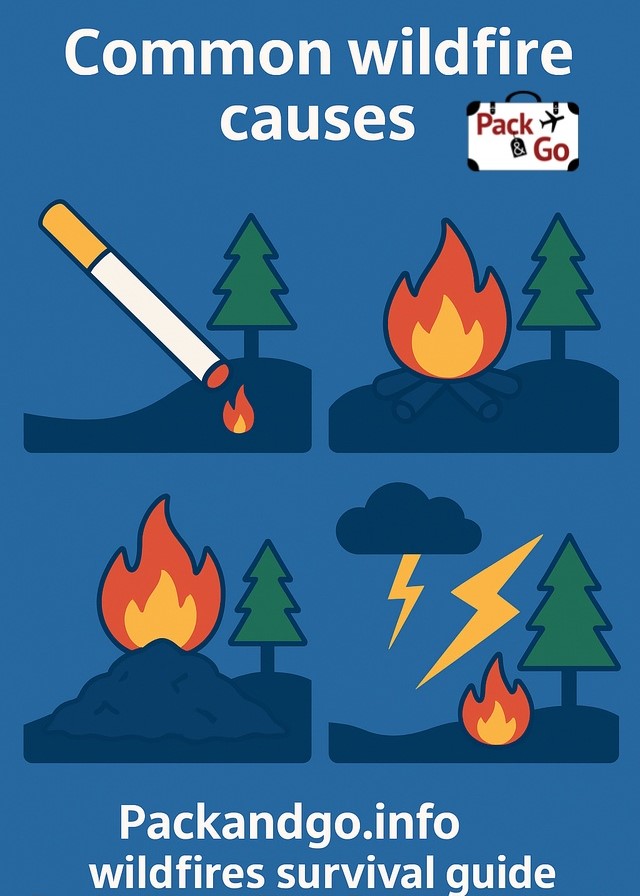
However, for many experts, this answer oversimplifies and relieves humans from responsibility. For them, wildfires are mostly human-caused or influenced, to say the least, because intentionally or accidentally, the initial spark starts as a direct result of a human activity. The US Environmental Protection Agency (EPA) statistics support this, stating that 85-90% of wildfires are caused by human activities and only 15-20% are the tragic result of natural events. Let’s go deeper to explain this controversy!
Even though natural causes truly are responsible for many wildfires, their current intensity, scale, frequency, and destructive power have heavily increased due to land management practices and climate change. These two factors have dramatically altered our current environment, and humans are directly involved. Just think about climate change, driven by greenhouse gas emissions (caused by transportation and heat, burning fossil fuels for electricity, deforestation, agricultural practices such as livestock farming, etc.). It creates hotter, drier conditions, extending fire seasons, and increasing the flammability of vegetation.
Additionally, years of fire suppression policies have increased the fuel in forests, creating a tinderbox only waiting for a spark. When the inferno is on, we all think fire is absolutely bad, but consider that it is part of life on Earth and a factor in keeping healthy ecosystems. It naturally helps to clear dead wood, nourish the soil, and help new growth. Such human policies have definitely influenced the environment. The result? Every season, fire grows longer, and every blaze burns fiercer.
Where can a wildfire occur?
Wildfires occur around the globe, all year round! Where there is oxygen, vegetation, and a source of heat or ignition, a fire can take place. Add strong winds, and it can go wild! Of course, some regions are far more vulnerable due to their climate, geography, and land management practices. Understanding where wildfires happen and why helps all of us to prepare, prevent them, and survive. So, here we go!
Latitude and hemisphere
Tropical and subtropical zones (between 23° N and 23° S) are really prone to wildfires due to conditions like the long dry seasons followed by lightning storms these areas experience, and the land clearing practices for agriculture. Both are common triggers of deadly wildfires yearly. Translated to regions, we are talking about Central Africa, the Amazon Basin (Brazil, Bolivia, Peru), Southeast Asia (Indonesia, Thailand), and Northern Australia. As a reference, Indonesian peatland fires often smolder underground for months, producing thick smoke that affects neighboring countries. Forest fires in Indonesia and Siberia already emit more carbon annually than the transportation sector.
Temperate zones
Between 23° and 66° latitude in both hemispheres, the risk of ravaging wildfires increases because of the hot-dry summers and the mild-wet winters these zones experience. These conditions create a dangerous combination and the perfect cycle for infernos to happen. Such winters create more than enough lush spring growth; the perfect and tragic fuel for summer fires. This is exactly what happens every year in regions such as California and the Pacific Northwest (USA), Chile, the Mediterranean basin (Spain, Italy, Greece, Turkey), South Africa’s Cape region, southern China, and parts of Australia. Imagine if you add to these conditions a discarded cigarette or an unattended campfire, yes, the result is hell. Prevention is urgent! Think about California, where there is no longer such a thing as a “fire season”. Wildfires are happening pretty much all year round, with Santa Ana winds accelerating flames across dry hillsides.
Boreal and subarctic zones ( 50° N and above)
Boreal ecosystems have a subarctic climate and are located in the Northern hemisphere. They are commonly known as taiga, and you can find them in parts of Asia, North America, and Europe. Conditions here can totally combine to create wildfires. Picture in your head the vast conifer forests with beautiful trees rich in resins (fuel for fire), the rising temperatures (these areas are warming more than twice as fast as the global average, leading to drier conditions in the soil, making vegetation more flammable), prolonged dry periods that accumulate more organic matter (a significant fuel source), thawing permafrost exposing previously protected organic material, and longer fire seasons (starting earlier in spring and extending later into autumn). All of this increases the likelihood of wildfires even outside traditional summer months, in regions like Canada, Alaska, Russia, and Scandinavia.
Arid and semi-arid regions
The Southwestern United States, Northern Mexico, the Middle East, Central Australia, or North Africa are good examples of places where sparse vegetation (brush, grass, etc.), but extremely dry, easily becomes fuel for fire, facilitating its propagation through scrub and grasslands. Already the Australia’s outback has shown how lightning-sparked grassfires can travel dozens of kilometers in only a few hours.
Continents threatened by wildfires
By now, you can easily infer that wildfires can occur in every single continent, with emphasis on places that feature the right conditions for the fire to ignite. For that reason, we will only mention the hotspots for the fire to spark.
North America’s dense forests, mountainous terrain, high winds, and drought make it very prone to wildfires. Climate change’s influence over these conditions and the expansion of human settlements near wildland areas have turned the Western US (California, Oregon, Washington), and Canada (British Columbia, Alberta) into wildfire hotspots. South America’s long dry seasons, agricultural burning, and deforestation increase the risk for wildfires to ignite, especially in the Amazon Basin, Brazil’s Cerrado, Chile, and Argentina. Think that fires here, resulting, for instance, from land clearing, get massively amplified by the drought.
Europe is facing drastic changes in climate, leading to hotter, drier, and windier summers that, combined with dense shrubland (“maquis” and “garrigue”), set the stage for fire to easily spark. northern regions like France, Germany, and even Scandinavia, and Mediterranean countries such as Spain, Portugal, Italy, Greece, and Turkey are experiencing exactly this. Africa records the world’s highest number of fires yearly. Many are grassland fires tied to human activity like agriculture. Seasonal grass fires are common and sometimes part of agricultural cycles; however, they can go out of control. Wildfire hotspots include Sub-Saharan Africa, especially Angola, the Democratic Republic of Congo, Tanzania, and South Africa.
Asia is the stage for deforestation fires, peat fires, and lightning-caused fires in boreal forests. Hotspots include Indonesia, Thailand, India, China’s Yunnan and Sichuan provinces, and Siberia. As a reference of their severity, only Rusia’s wildfires and Indonesia’s peatland fires contribute significantly to global CO₂ emissions. In Australia and Oceania, bushfires have always been part of the ecosystem. However, they are noticeably intensifying in scale and frequency due to prolonged droughts, hot winds, eucalyptus trees that naturally produce flammable oils, and climate change. This affects especially Eastern and Southern Australia and New Zealand’s grasslands.
How to survive a wildfire? What to do before, during, and after a wildfire?
At this point, you know that when a wildfire threatens your area, every second counts. Preparation, quick thinking, and knowing what to do can mean the difference between dying and surviving. Since wildfires can happen pretty much everywhere, here is how to protect yourself, your loved ones (pets and livestock included), and your home before, during, and after a wildfire. Don’t join tragic statistics. Ensure you read our wildfire survival guide and be ready for the unexpected!
BEFORE a wildfire: Prepare before smoke appears!
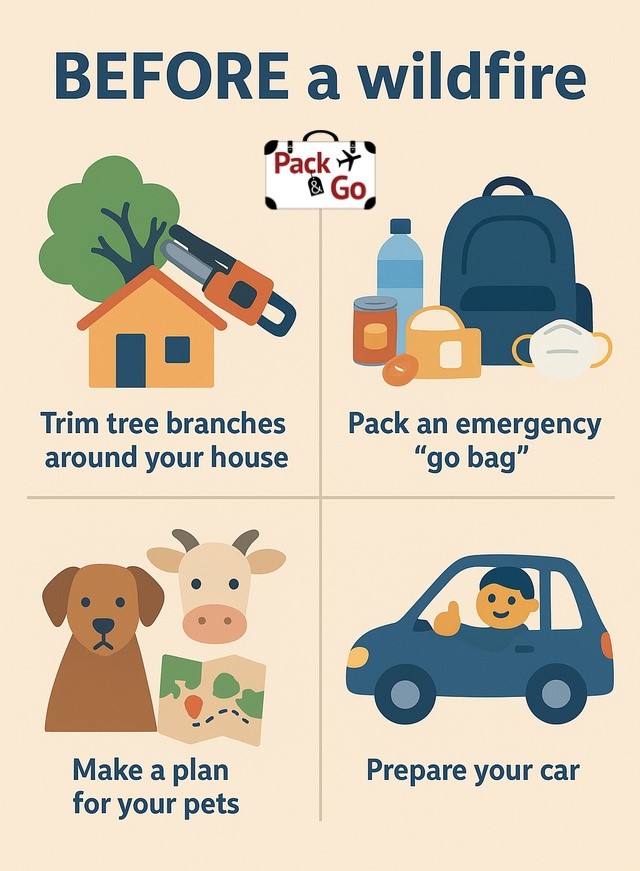
- Create a defensible space around your home. This measure can protect your home, and if the threat is a huge and savage fire, it creates a buffer to try to slow the fire’s advance and give firefighters a fighting chance.
- Clear at least 30 meters (100 feet) around your house of dry grass, leaves, or flammable debris.
- Trim tree branches so none hang over your home’s structure (for instance, the roof).
- Keep propane tanks, woodpiles, and vehicles away from your house.
- Use fire-resistant materials (metal, tile, or treated wood) for roofs and decks.
2. Pack an emergency “go bag”
Prepare a backpack ready to grab in seconds. It should contain:
- Water. Minimum 4 liters (1 gallon) per person, per day, for at least 3 days (so, for two adults, store 24 liters / 6 gallons, and so on).
- Non-perishable food. Enough for 3 days (canned meals, nuts, dried fruits, grains).
- Food and water enough for 3 days, for pets evacuated (if any).
- First aid kit, necessary prescriptions and medications, and important documents or copies of them.
- Flashlight, batteries, multi-tool, dust masks (N95), a battery-powered radio, whistle, and phone charger.
- Protective clothing. Long sleeves, pants, sturdy shoes, goggles, and a bandana. A change for every person.
- Cash, credit cards, and keys.
- Additional eyeglasses or contact lenses.
- A map with two (at least) clearly marked evacuation routes.
- Sanitation supplies.
3. Plan evacuation routes
- Identify at least two exit routes from your neighborhood.
- Practice leaving quickly. Know where your local shelters or safe zones are located.
- Get local escape maps, if available, and download offline maps.
- Save emergency numbers.
- Choose a spot for reunification with other members of your family if you are separated. Define the route and means to reach it.
4. Make a plan for evacuating pets
In case you have pets, service animals, or livestock, research in advance how they will be transported and potential locations where they could stay during the evacuation. Calculate the food and water they may need. Don’t wait for the emergency to define this. When a wildfire blazes, time is ticking for you and your animal friends.
5. Prepare your car
- If you have a vehicle, keep it fueled (at least half full, especially during wildfire season) and parked facing outward for a fast departure.
- Carry emergency water, a wool blanket, N95 mask(s), a flashlight, and a basic first-aid kit.
- If you are on vacations in a wildfire-prone area, park with access to a clear turnaround and away from flammable materials.
- Pay close attention to authorities’ information, guidance, and official evacuation orders.
6. Stay informed
Download emergency alert apps, follow local fire departments on the news, traditional, or social media, and keep a battery-powered radio in case the power or the Internet fails.
DURING a wildfire: Act fast. Every minute counts!
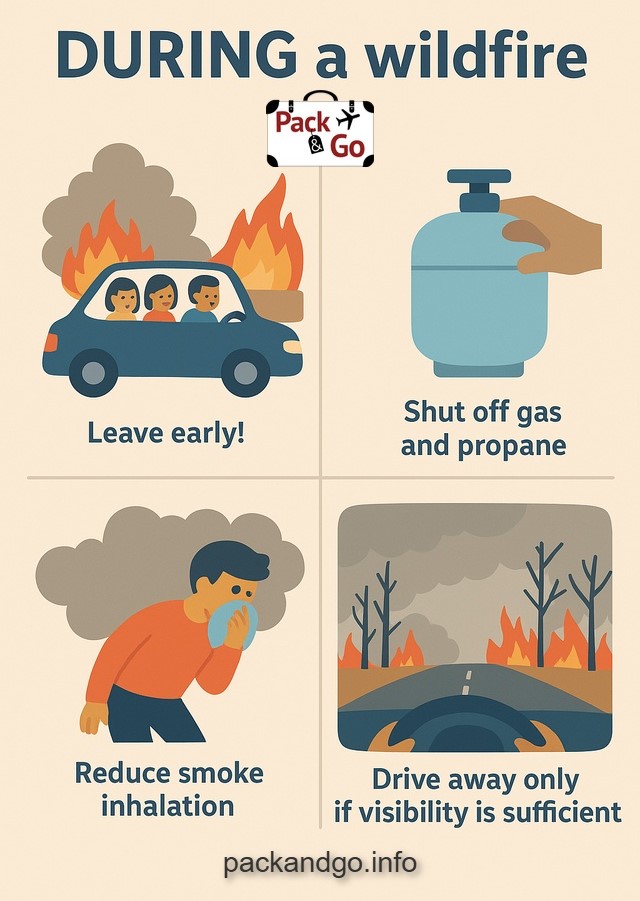
1. Leave early. Don’t wait for mandatory evacuation
If a fire is nearby and you feel unsafe, go right now. You are already prepared (previous steps, before a wildfire). Fires move quickly and unpredictably due to the wind. Waiting can trap you.
- Take your “Go Bag,” pets, and essentials.
- Close all windows and doors, but don’t lock them totally, in case firefighters need access.
- Leave exterior and interior lights on to enhance visibility of the house in thick smoke.
2. If you must stay temporarily, make your home defensible
- Shut off gas and propane.
- Fill bathtubs, sinks, and buckets with water, not to drink, but to douse spot fires.
- Move flammable furniture away from windows.
- Close vents and doors to slow smoke infiltration.
- Disconnect automatic garage door openers, so they can be manually opened if electricity is lost.
3. If you are caught by the fire outdoors or in a vehicle
On foot:
- Move downhill and away from the fire’s path (fire travels uphill fast).
- Cover your mouth and nose with a cloth to reduce smoke inhalation.
- Look for cleared areas like a road, rocky field, or body of water.
- Lie face down in an area with little vegetation if trapped; protect your airway. Smoke kills more often than flames.
In a car:
- Be aware of the severity and speed of the fire around. Follow these tips based on the exact situation you are in because staying inside your car could save you or kill you. It requires fast, decisive action (evacuate on foot, drive through, or shelter in a car). The safest option depends on visibility, road conditions, fuel, and fire behavior.
- Get out of the path of the fire if you can safely identify one. Moving away from heavy smoke, flames, and strong winds is a priority.
- Maximize your ability to breathe and see. Shut windows, set climate control to recirculate, cover nose and mouth with a damp cloth if available.
- Preserve vehicle survivability. Turn on hazard lights and headlights, keep the engine running only if moving to safety, and avoid parking where the car can easily be reached by fire (dry grass, leaves).
Abandon vehicle on foot:
- When a vehicle is not survivable and a safer refuge is nearby.
- Only if you can reach a clear, open area with little to no vegetation (plowed field, riverbank, rock, pavement) and you can move faster than the approaching fire front.
- Wear long trousers, boots, long-sleeve shirt, and cover nose and mouth with damp cloth. Avoid uphill routes where fire moves faster.
- Stay low and move perpendicular to the wind direction when possible. Wind makes fire more deadly powerful, but it can be your guide while on foot.
- Do not run into dense smoke. If smoke is unavoidable, move low and at a steady pace.
- Always head for non-flammable terrain. Search for nearby areas free of trees and brush. If possible, try to put a body of water between you and the fire. Go to already burned areas, after confirming they are completely extinguished, and still carefully protect yourself from burns and breathing smoke.
Drive away if:
- Visibility is sufficient to navigate at reduced speed (no pitch-black smoke), avoiding collisions, obstacles, livestock, and people.
- There is a clear, known route away from the fire and smoke. Confirm visually an open road ahead.
- Road is clean enough, without other vehicles already stuck, downed trees, debris, or flames blocking it.
- Wind/fire direction appears to be moving away or across the road rather than toward you.
- You have enough fuel, and the vehicle is mechanically sound.
- Drive with windows up, headlights on, and vents closed to reduce smoke intake. Reduce speed but avoid stopping. Maintain situational awareness for changing conditions.
Do NOT drive through if:
- Thick, opaque smoke prevents you from seeing the road or hazards.
- Flames are across the road or on both sides, and the fire is intense.
- Road is blocked, congested, or collapsed.
- You would have to drive toward the visible head of the fire or uphill into it.
In these cases, consider abandoning or sheltering the vehicle as described below.
Shelter in vehicle (last-resort defensive survivability):
- Park in a clear area. Avoid places near trees, dense bushes, or brush (fire’s fuel). Choose a paved area, rock, gravel, or a cleared bare zone.
- Turn the engine off unless you must move.
- Stay inside if surrounded by fire. The metal body provides some protection.
- Leave headlights and hazard lights on so rescuers can see you.
- Roll up windows, close vents, set A/C to recirculate if you need, but do it briefly and turn it off to avoid drawing smoke.
- Cover yourself with a jacket or blanket. Keep water on hand to wet clothing/skin and reduce heat.
- Lie on the floor away from doors if flames and radiant heat are intense, because heat is highest near windows/roof.
- Call emergency services and give your exact location ( recognizable landmarks, mile marker, GPS coordinates, or). If no signal, conserve battery for periodic attempts.
- Once the flames pass, exit carefully when it is safe. The car may become too hot.
4. Protect your breathing
Smoke kills more often than flames. Use N95 masks or a damp cloth to filter smoke. Stay low where the air is clearer.
AFTER a wildfire: Survive the Aftermath
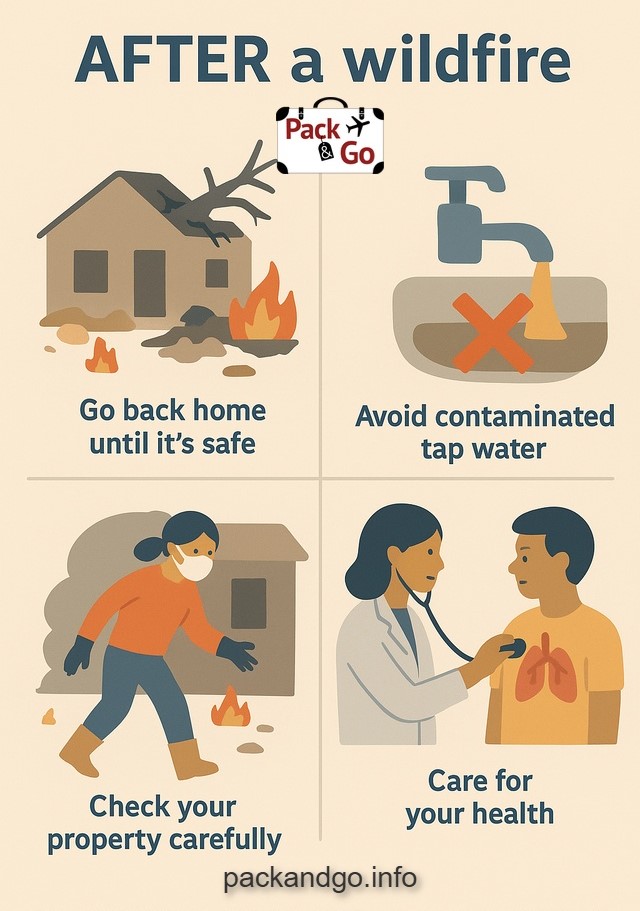
- Wait for official clearance before returning home
Hot spots and falling debris may remain. Return only when authorities say it is safe.
2. Do not drink or use tap water until officials confirm it is safe
It may be contaminated.
3. Check your property carefully
Wear gloves, boots, and a mask to check and identify smoldering embers, gas leaks, or weak structures.
4. Document and report damage
Take photos or videos for insurance claims. Contact your insurer as soon as possible.
5. Care for your health
Wildfire smoke exposure can cause respiratory issues, headaches, and anxiety. Rest and stay hydrated. If you experience coughing, shortness of breath, or dizziness, seek medical help.
6. Rebuild safely
When rebuilding or cleaning, use masks and gloves. Dispose of burned materials properly. Ash and debris can contain toxic residues.
Conclusion
Wildfires are no longer distant disasters we watch unfold on the news. They are faster, hotter, and more unpredictable than ever. From forests and grasslands to suburbs and mountain towns, no place is truly immune. As wildfire season expands across continents and climates, the danger grows not only for the land and wildlife but for every community living in today’s rapidly warming world.
But awareness is power! Understanding why wildfires are getting worse, recognizing where they strike, and learning how to survive a wildfire can be the difference between dying and surviving. Creating defensible space, preparing a wildfire evacuation plan, and staying informed are not optional precautions anymore. They are essential actions for protecting your life, home, and family.
The threat is real, and the clock is ticking. Wildfires are spreading faster than ever. The question now is simple: Are you prepared to survive the next one?
Wildfire FAQs
Why is a wildfire so deadly?
Wildfires are deadly due to their current severity, destruction power, greater energy release, rapid spread, fueled by dry conditions and strong winds, which can catch people off guard and make escape difficult. Additionally, the smoke produced contains harmful pollutants that can cause serious health issues, exacerbating respiratory and cardiovascular problems, especially in vulnerable populations. One spark truly can ignite a disaster. Wildfire preparedness is life-saving!
What causes most wildfires today?
Today, most wildfires are caused by human activities. Common ignition sources include unattended campfires, tossed cigarettes, power line failures, and sparks from equipment. Climate change intensifies the danger by creating hotter, drier conditions, making vegetation far more flammable, and increasing overall wildfire risk.
How can I prepare my home for wildfire season?
To reduce wildfire danger, create at least 30 meters (100 feet) of defensible space around your home. Clear dry leaves, trim trees, remove flammable materials near structures, and install fire-resistant roofing or siding. Preparing an emergency kit and a wildfire evacuation plan ensures your household is ready to leave safely when a fire approaches.
What should I do if a wildfire is heading toward my area?
If a wildfire is near, be informed and follow official alerts. Evacuate early because waiting too long puts you at extreme risk. Pack your “Go Bag,” wear protective clothing, close windows and doors, and. Be prepared! Read our guide completely to survive a wildfire.
Where do wildfires happen most frequently?
Wildfires occur in many regions and hotspots such as California, Canada, the Mediterranean basin, Australia, Siberia, and parts of South America and Africa. Any area with dry vegetation, heat, wind, and a spark can experience wildfire, even places not traditionally seen as fire-prone.
How do climate change and drought increase wildfire danger?
Climate change is making wildfires worse by raising temperatures, lengthening wildfire season, and intensifying drought. Dry vegetation becomes easy fuel, while heatwaves and strong winds help fires spread faster and farther. These conditions create the “perfect storm” for extreme wildfire behavior and larger, more destructive outbreaks.
| Follow PackAndGo.info at: | |
| YouTube | @packandgo. |
| @packandgo.info | |
| X | @packandgoinfo |
| Bluesky | @packandgo.bsky.social |
| @packandgo.info | |
| TikTok | @packandgo.info |
You may also be interested in:
Floods can strike unexpectedly: Are you really prepared to survive?
What to do before, during, and after an earthquake?
Tsunami, the wave that you don’t want to see
Hurricane, what to do when it approaches?
War tips for tourists who get trapped in a conflict
Floods can strike unexpectedly: Are you really prepared to survive?
- Details
- Written by: Gianna Esquivel
- Hits: 609
Every year, floods strike everywhere, from cities to coastlines and valleys. That is very scary! It really worries us the idea of being trapped in such a situation, at home or in a different country. Just think about it: you are in Italy, Vietnam, the US, or Mexico on holiday, and suddenly a tropical storm or a river or dam overflow occurs. Are you ready to survive the floods? Do you know what to do if the water becomes a mortal threat? Streets can turn to rivers in a matter of minutes, sweeping away cars, buildings, trees, and people; everything in its way. It is not an exaggeration, and unfortunately, no guys, being an excellent swimmer is no guarantee of survival when a flood occurs. Let’s prepare right now to be ready for the unexpected! Read this flood safety guide until the end before it is too late!

Deadly floods 2025
This is only a small sample of evidence to prove that deadly floods are happening everywhere, resulting in plenty of catastrophes, significant loss of life, and extensive damage.
- February. During late January and February, intense monsoonal rains driven by a tropical low-pressure system struck northeastern Queensland, Australia. The heavy rainfall caused rivers to overflow and triggered widespread flooding in coastal towns. Thousands were evacuated. The disaster resulted in one immediate fatality and led to a post-flood outbreak of melioidosis, which claimed thirty-one more lives.
- February. In the middle of the month, an Arctic cold front unleashed a merciless storm over Kentucky, Appalachia, and parts of Tennessee and West Virginia, US. The relentless precipitation over mountainous terrain inundated several areas, reaching 8–9 inches (20.32–22.86 centimeters) of water in only a few hours. It triggered deadly flash floods that quickly overwhelmed rivers and drainage, sweeping through dozens of roads and rural hollows, forcing over one thousand rescues, and killing eleven people (most drowned when houses collapsed).
- March. Months of unrelenting rains spilling over Bolivia from late 2024 caused widespread deadly floods in the country, killing dozens and displacing three hundred and seventy thousand families.
- June. Pakistan got hit by monsoon rains, which rapidly triggered flash floods and landslides, particularly affecting Khyber Pakhtunkhwa and causing approximately eight hundred deaths and massive destruction.
- June. A heavy rain-induced glacial lake outburst caused the collapse of a reservoir dam in the Andarab Valley, Baghlan province, Afghanistan. Deadly flash floods arose and washed away five villages, hundreds of hectares of crops, and destroyed mosques and bridges.
- June. It was the turn of the Eastern Cape, South Africa. A powerful cold front unleashed torrential rains that caused rivers to burst their banks, creating disastrous floods, displacing thousands, and killing more than a hundred people.
- July. Central Texas, US, suffered heavy rainfall that triggered devastating flash floods, more than 20 inches (50.8 centimeters) of rain, leading to an emergency situation, widespread evacuations, and infrastructure damage. Fatalities reported were one hundred and thirty-five, and nearly two hundred missing people.
- July. Nepal was struck by a glacial lake outburst flood that destroyed infrastructure and swept away communities near the border with China. Officially, it left twenty-eight deaths.
- July. More than forty people died as a result of heavy rainfall that led to flooding in Beijing, prompting evacuations and emergency responses.
- August. Heavy rainfall created deadly flash floods in Uttarkashi, India, resulting in more than a hundred deaths and an undefined number of missing people.
- October. Mexico joined the scary list. Deadly floods and landslides caused by the remnants of hurricane Priscilla and tropical storm Raymond resulted in significant casualties, damage, and an undefined number of fatalities.
And the year is not over yet... Better keep reading the Pack and Go flood safety guide!
| Follow PackAndGo.info at: | |
| YouTube | @packandgo. |
| @packandgo.info | |
| X | @packandgoinfo |
| Bluesky | @packandgo.bsky.social |
| @packandgo.info | |
| TikTok | @packandgo.info |
Why does a flood happen? Floods vs. Flash floods.
A flood happens when water inundates land that is usually dry. Many causes can be behind the formation of a flood, for instance, heavy rain, glacial lake outbursts, rivers overflowing, melting snow, storm surges from hurricanes, or even the rupture of dams or levees. Floods can last for days or even weeks, slowly spreading and affecting wide areas, damaging homes, roads, crops, and sometimes entire towns or cities.
A flash flood, on the other hand, is a much faster and more dangerous version of a flood. It happens suddenly, frequently within minutes or only a few hours after intense rainfall, a dam failure, or a sudden release of water. Since flash floods happen so quickly, you have little to no time to prepare or escape. You must make decisions really fast to survive. Flash floods can sweep away cars, trees, electricity poles, animals, and even buildings. They are one of the deadliest natural disasters.
The main difference between a flash flood and a regular flood is speed and warning time. Regular floods rise slowly, giving people time to evacuate or protect their property. Flash floods strike fast and hard, often catching people by surprise.
Adding to this destructive power, climate change is making such events more extreme. A warmer atmosphere retains even more moisture; therefore, powerful precipitation and flash floods are happening more frequently.
Why is a flood so deadly?
Floods may seem simple, just too much water, but behind every flood are three key forces that make them so destructive: power, unpredictability, and risk. In other words, the power of water can be massive! Yes, water is far stronger than it looks. Just six inches (15.24 centimeters) of fast-moving water can knock a person off their feet, and two feet (60.96 centimeters) can carry away a car. Consider that floodwater also carries debris, rocks, branches, and pieces of metal that can destroy homes, roads, and bridges. The flatter your area, the longer water may stay, while steep slopes or canyons channel water faster, increasing flash flood danger.
Unlike slow-rising floods from overflowing rivers, flash floods can appear with little or no warning, especially after intense rain, dam ruptures, or when the ground is already soaked and can’t absorb more water. Did you know that urban areas are particularly vulnerable? Yes! The reason is that the concrete and asphalt prevent rain from soaking in, sending it rushing through streets instead.
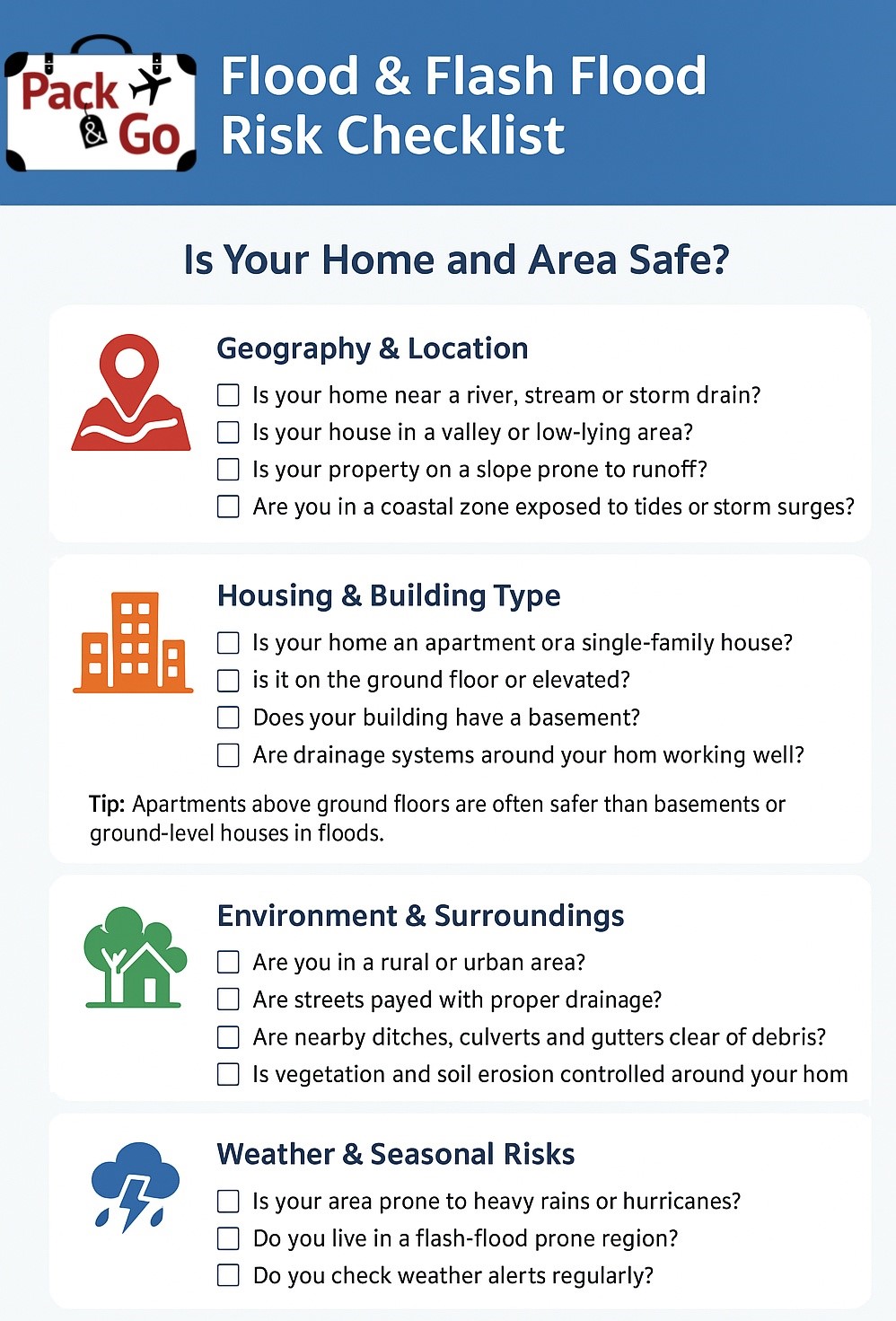
How to identify the flood risk level of the area where you live?
Several conditions can raise or lower your flood risk, and assessing them in advance can save your life. Living near water can be beautiful and even beneficial, with cooler air, fertile soil, and lovely views, but awareness is key. The power of water means floods can change landscapes overnight. So, understanding the terrain, climate, and warning systems around, you can certainly turn unpredictability into preparedness! That is your chance to keep your home and loved ones safe. Check:
- Weather patterns. Regions with hurricane or monsoon seasons face seasonal flood threats, while mountainous areas risk flash floods from melting snow.
- Geography. Where are you? Is your home near a river, stream, or bay? Low-lying regions, valleys, riverbanks, and coastal areas face the highest danger. You can start by observing the terrain around your home. Does the water pool after rain? Are there steep hills or dry creeks nearby? Those are early clues. Watch out and check local floodplain maps for more accurate information.
- Proximity to water structures. Do you live near a dam, levee, or reservoir? That can be a blessing and a risk. Such structures sound like a guarantee of water supply, and yes, they help to control water... until they don’t. Dam failures or overflows can cause catastrophic flash floods.
- Environment. Cities have excellent drainage systems, but during storms, sewers can overflow. Countryside homes near creeks or slopes face risks of flash floods and mudslides. As you see, it is not about fleeing away from the city or the countryside. Floods can happen in both environments. The idea is to assess the risk wherever you live.
- Type of housing. Apartments on upper floors are safer from flooding than single-level houses, but access roads may still flood, trapping residents. Are you a tourist or new to an area where you plan to buy a house or apartment? Ask neighbors or local authorities about past floods to be aware of. History often repeats itself.
How to stay safe during floods?
Floods are silent emergencies; they build fast, strike hard, and leave little time to think. The best protection is preparation, awareness, and knowing what to do when water starts rising. Remember that floods can happen almost anywhere, and climate change has made them more unpredictable and powerful than ever. How to stay safe during floods, no matter where you live (from city apartments to coastal houses)? Here you have a list of smart flood survival tips for every environment.
General flood survival tips
- Stay informed. Keep your phone charged and follow weather apps, local alerts, or radio updates.
- Move to higher ground immediately. Whenever you see fast-rising water, don’t wait for official evacuation; leave without hesitating.
- Never drive, walk, or swim through floodwater. Now you know, just six inches (15.24 centimeters) can knock you down, and two feet (60.96 centimeters) can sweep your car away. Swimming in dark water, with a strong current, you won’t see or avoid debris. Rocks, metal pieces, tree branches, etc., can knock you out and delete your chances of survival. If you did not have time to leave your car (that is your best choice) and get trapped inside it, unbuckle your seatbelt, open your doors and windows before they get blocked due to the pressure of the water outside or a failure in the electric systems. In an extreme case, once the car fills with water, the pressure inside will match the outside, allowing you to open the door.
- Always act quickly. Frequently, you have only a minute to escape before the situation worsens.
- Disconnect electricity. Water and power are a deadly mix. Disconnect it, only if you still have time and it is safe to do so.
- Prepare a go-bag. Include medication, flashlights, food, water, ID, and pet essentials. This bag must be ready in advance for you to take it and leave without wasting time.
- Keep your phone and a power bank dry. Communication saves lives.

Flood survival tips for the city
Remember, cities flood quickly because pavement blocks natural drainage. You are not safe there only because you don’t see a river nearby. If you see fast-rising water, act immediately:
- Avoid underground garages, basements, and subway stations; they fill up first.
- Search for safe zones quickly. Upper floors of solid buildings, parking decks above ground level, and rooftops (if accessible and safe from power lines). Always avoid attics without windows or exits.
- Avoid large intersections and lower-level roads. Storm drains can burst and form whirlpools.
- If in a car, turn around immediately when water crosses the road.

Flood survival tips for the countryside
Rural floods can turn fields into lakes and streams into raging rivers in minutes. Never underestimate them!
- Move livestock and pets to high ground early.
- Stay away from rivers, creeks, and bridges. These structures collapse easily under strong currents.
- If roads flood, stay put until rescue arrives. Consider seriously that rural roads can be really deceptive under murky water.
- Store emergency food, batteries, and clean water. Power and access can be lost for days.
- Move to safe zones. Identify such areas in advance, so, in case of a flood, you don’t waste time and move fast to hilltops, elevated terrain, or upper floors of sturdy homes.

Flood survival tips for the apartment building
Apartment dwellers are safer from direct flooding but must still act wisely and without understimating fast-rising water.
- Move vehicles from the underground parking immediately when heavy rain is forecasted.
- Avoid elevators. If the power cuts, you could get trapped.
- Stay on mid to high floors, but not attics without ventilation.
- If water cuts off exits, move toward balconies or rooftops where rescuers can spot you.
- Go to safe zones. Identify such zones in advance, so in case of emergency, you can go quickly to upper floors, accessible levels, rooftops with a railing, and emergency exits.
Flood survival tips for the house
Know that houses face a higher risk of basement flooding and foundation damage.
- Keep sandbags or flood barriers ready during storm season.
- Elevate electrical outlets, appliances, and valuables when living in flood-prone zones.
- Move family and pets upstairs when flood warnings hit.
- Have an emergency ladder for attic escape if necessary.
- Identify safe zones in your home. Upper floors, attics with roof exits, and second-story rooms away from windows facing strong currents.
Flood survival tips for the valley
Valleys are natural flood funnels. Water from higher areas rushes down really fast. So:
- Leave early if storms are forecasted. Flash floods here are deadly and sudden.
- Know the nearest elevation routes and evacuation points.
- Avoid camping or staying overnight near rivers or creeks during rainy seasons.
- Identify safe zones in advance. Know where to go during the emergency: elevated terrain, ridge lines, high roads far from riverbanks.
Flood survival tips for the coast
Coastal floods combine storm surge, rain, and wind. They can be a deadly mix! So:
- Don’t wait until the water rises. Evacuate inland early.
- Secure windows and doors. Strong waves can break glass.
- Watch for rip currents and debris after the flood. Never return until authorities declare it safe.
- Identify safe zones. Knowing where to go in advance, don’t waste time and run to inland areas, designated hurricane shelters, high-ground hotels, or public buildings.
Flood survival tips for the car
- Always check weather alerts before driving.
- Never park near rivers, ditches, or storm drains during heavy rain.
- Keep an emergency flood tool and flashlight in the car.
- Leave the car. If there is fast-rising water, your best decision is to leave the car and go to a high place, before water gets inside your car or blocks the doors.
- Leave everything behind. Forget bags, phones, or valuables. Your life is the only thing that matters.
- Stay calm and think fast. If you did not leave your car on time and the flood is already significant, don’t panic! That burns time. Take a breath, observe what’s happening, and make a plan. Clear thinking saves lives.
- Turn around, don’t drown. If water is rising on the road, do not drive through it. Just 6–12 inches (15.24 – 30.48 centimeters) can stall your engine, and 2 feet (60.96 centimeters) can sweep your car away.
- Unbuckle immediately. Once water begins entering the car, remove your seatbelt right away so you can move freely.
- Unlock and open all doors and windows. Power systems can fail fast. Open doors and windows immediately, even before water rises. Here, you need to really observe your specific situation and be smart. You can open the windows first and, based on how fast the water is rising, decide whether or not to open the doors. Why? Your best bet is to escape your car as soon as you have a clear opportunity. Many people die in their cars due to blocked windows and doors. This will stop and delay your rescue. Remember that once the water is high, its pressure will block the doors. The same (or a failure in the electric systems) will happen to your windows once the water is high enough to cover them. In an extreme case, once the car fills with water, the pressure inside will match the outside, allowing you to open the door. However, by then, it can be too late. Opening the doors immediately will provide free access to water, and if it is too cold and enough to cover your legs and body, that is not a good combination with a long wait for emergency services to rescue you. Therefore, analyze your case and decide fast.
- Escape through a window rather than the door. Especially when the flood already causes a strong and fast current, opening a door will let in a surge of water that can trap you. If it is still a viable choice, use the window as your exit.
- Use a window-breaking tool. If windows already don’t open, break the side window, not the windshield. Keep a small emergency tool in your car door at all times.
- Exit and move to higher ground. Once out, get on the roof only if you must, but your priority is to carefully swim or walk (only if shallow) to higher, stable ground.
- Avoid fast-moving water. Even 6 inches (15.24 centimeters) of rushing water can knock you down. Move diagonally away from the current, not against it.
- Call 911 only when you are safe. If you call immediately inside a sinking car, you lose escape time. Escape first, call second. Again, you need to apply judgment based on your specific situation. If calling 911 is our only choice because you are trapped and without a chance to escape, go ahead, call quickly.
Final flood survival tips. Be mentally ready!
- Plan now, not later! Today is the best day to explore your home and surroundings to identify your safe exits, shelter locations, high areas, and emergency contacts.
- Talk to your neighbors. Floods are community challenges. Define a personal and group flood emergency plan, identifying the best escape routes, calculating a fast evacuation, and the necessary help to the elderly, kids, and pets.
- After the flood, be patient! Don’t re-enter buildings until they are cleared for safety. Watch for mold, contaminated water, and electrical hazards.
Conclusion
Now you know that floods can strike unexpectedly. They can happen pretty much everywhere in the world, in the city or the countryside. So, you must be prepared to survive! Knowing how fast they can develop, how destructive they are, and some flood survival tips is the first step. Preparation, having a flood emergency plan, is the next one! Remember that floods are not just about water, but about power, unpredictability, and risk. Understanding these, along with the environment you live in, can help you judge how vulnerable your area might be to a flood or a flash flood.
Floods can’t be stopped, but being prepared can turn a potential tragedy into a survival story.
Stay alert, stay smart and calm, plan in advance, think fast, and remember: the higher, the safer. When a flood hits, every second matters. Stay safe and keep tuned with packandgo.info!
| Follow PackAndGo.info at: | |
| YouTube | @packandgo. |
| @packandgo.info | |
| X | @packandgoinfo |
| Bluesky | @packandgo.bsky.social |
| @packandgo.info | |
| TikTok | @packandgo.info |
Page 6 of 6